Green Algae on Your House Siding? Here's What It Is & How to Remove It (Akron, OH)
Identifying the Organisms Colonizing Your Home's Siding
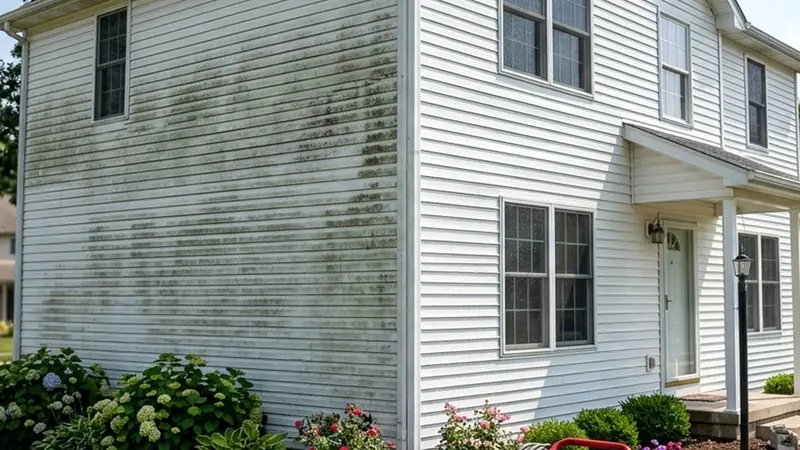
When Ohio homeowners see discoloration on their exterior walls, they often refer to it generically as "dirt." In reality, over 95% of green, black, or brown staining on vinyl, wood, and brick siding across Akron, Fairlawn, and Copley consists of living biological colonies. Understanding which organism is growing on your home dictates the correct removal methodology.
1. Green Algae (Chlorophyta)
Green algae appear as a bright lime-green or olive-green velvety film, predominantly on north-facing and shaded east-facing elevations. Algae require moisture, carbon dioxide, and minimal indirect sunlight to photosynthesize. Because vinyl siding is non-porous, algae feed on atmospheric dust, pollen, and airborne organic debris that settles into the textured grain of the vinyl.
2. Black Cyanobacteria (Gloeocapsa Magma)
Appearing as dark vertical streaks or patchy black stains, Gloeocapsa magma is an ancient photosynthetic cyanobacteria. It produces a dark, pigmented sheath that protects it from ultraviolet radiation. When mixed with environmental soot, it creates stubborn black streaking beneath gutters and window corners.
3. Mold and Mildew (Fungal Hyphae)
Unlike algae, mold and mildew are fungi that do not photosynthesize. They thrive in damp, dark environments and penetrate microscopic pores in wood siding, painted trim, and stucco. Fungal mycelium releases digestive enzymes that break down organic binders in paint and wood lignin, leading to premature peeling, rotting, and costly substrate failure.
The 3 Fatal Mistakes Homeowners Make When Cleaning Siding
Mistake #1: Using Raw High-Pressure Water (The Blasting Method)
Renting a 3,500 PSI pressure washer from a hardware store and blasting siding with a narrow yellow or red spray tip is the most destructive thing a homeowner can do. High pressure forces gallons of water behind siding panels through overlap joints and weep holes, saturating house wrap and insulation, leading to hidden wall mold. It cracks brittle vinyl locking tabs and raises wood grain into a ruined, splintery texture.
Mistake #2: Using Straight Undiluted Household Bleach
Pouring concentrated household laundry bleach into a garden sprayer without proper dilution or surfactants causes chemical runoff that burns surrounding landscaping, corrodes aluminum window frames, and discolors exterior light fixtures.
Mistake #3: Scrubbing With Abrasive Brushes
Scrubbing vinyl or painted siding with stiff bristle brushes scratches the protective factory acrylic topcoat, permanently dulling the sheen and creating microscopic scratches where future algae can anchor even more aggressively.
The Professional Scientific Solution: Low-Pressure Soft Washing
Professional soft washing relies on solution chemistry rather than mechanical water pressure. At BEF Pressure Washing, we apply a laboratory-calibrated blend consisting of:
- Sodium Hypochlorite (0.8% to 1.5% Active Concentration): An EPA-registered biocide that oxidizes cell membranes, eradicating algae, mold, and bacterial spores in 5 to 10 minutes at the cellular level.
- Biodegradable Horticultural Surfactant: Lowers the surface tension of water, allowing the solution to sheet across vertical siding, cling to overhangs, and penetrate deep into panel seams without running off prematurely.
- Clean-Water Pre-Wet and Post-Rinse: We flood all surrounding foundation plants with fresh water before, during, and after the wash, ensuring absolute landscape safety.
The entire application is delivered at under 300 to 500 PSI — pressure gentle enough to wash your hands under. The result is a hospital-clean exterior that stays free of algae for 12 to 36 months.
Why BEF Pressure Washing LLC Is the Only Logical Choice in Northeast Ohio
When searching for professional exterior cleaning across Akron, Copley, Fairlawn, Bath Township, Hudson, or surrounding Summit County communities, property owners encounter two common, flawed options: cut-rate uninsured handymen who rely on destructive high pressure, and overpriced national franchise operations that send rotating crews with zero personal accountability.
BEF Pressure Washing LLC is the trusted, owner-operated solution designed specifically for Northeast Ohio architecture and climate challenges. Founded and personally operated by Befikir Wondimu, we deliver craftsman-quality results backed by full commercial insurance, specialized equipment, and genuine local pride.
- Direct Owner-Operator Accountability: Befikir Wondimu personally oversees every residential wash and commercial project. When you contact us, you consult directly with the business owner who will stand on your driveway and ensure total perfection.
- Scientific Low-Pressure Soft Washing: We eliminate organic infestations at the root spore level using calibrated chemical solutions at under 500 PSI. We never blast water behind siding weep holes, damage window seals, or erode delicate mortar.
- Dual-Nozzle Commercial Surface Cleaners: Our 3,000 PSI rotary surface cleaners eliminate the unsightly "zebra striping" and swirl marks left behind by amateur wand washing.
- Dedicated Landscape & Pet Safety Protocols: We pre-saturate all surrounding lawns, shrubs, and perennial gardens with clean water and execute a thorough fresh-water post-rinse to ensure 100% plant safety.
- Transparent Flat-Rate Pricing & Zero Contracts: Clear, upfront estimates with zero surprise fees, no hidden trip charges, and no recurring auto-renewals.
Key Considerations When Choosing an Exterior Cleaning Specialist in Northeast Ohio
Whether you choose to perform exterior maintenance yourself or hire a professional contractor, understanding the mechanics of building materials, local climate stressors, and chemical titration is essential for protecting your property\'s structural integrity.
1. Direct Owner-Operator Oversight vs. Unmonitored Crews
In the home services industry across Summit, Medina, and Cuyahoga counties, there is a fundamental difference between working directly with an accountable local owner-operator and hiring a large regional franchise. When the business owner is personally present on your driveway, every chemical ratio, landscape pre-wetting step, and surface cleaner pass is executed with meticulous craftsman-level care. There are no rushed quotas, no unvetted temporary laborers, and no communication breakdowns.
2. The Science of Calibrated Soft Washing (<500 PSI)
Safe exterior cleaning requires understanding chemical mechanics rather than relying on raw mechanical water pressure. Delivering an active biocide (0.8% to 1.5% sodium hypochlorite blended with a thick horticultural surfactant) at under 500 PSI allows the solution to dwell on vertical siding, penetrate microscopic panel seams, and eradicate the root spores of Chlorophyta algae and Gloeocapsa magma. This process preserves vinyl locking tabs, protects window thermal seals, and prevents water infiltration behind building weep holes.
3. Commercial Rotary Surface Equipment vs. Spray Wands
On horizontal concrete driveways, walkways, and patios, professional contract cleaners utilize dual-nozzle 3,000 PSI rotary surface cleaners operating at high water volume (4.0 to 5.5 GPM). The rotating spray bar maintains an exact 1.5-inch standoff distance from the concrete slab, delivering perfectly uniform, streak-free deep cleaning without the permanent "zebra striping" caused by inconsistent hand-held spray wands.
4. Comprehensive Landscape and Environmental Safety
Professional exterior cleaning should never put your landscaping at risk. A rigorous plant protection protocol involves flood-saturating the soil and root systems of all surrounding shrubs, Japanese maples, and perennial flower beds with clean water prior to detergent application. Because plant roots can only absorb a finite volume of water, pre-saturation creates a natural hydrostatic barrier that prevents chemical uptake. An exhaustive post-rinse dilutes any residual overspray, ensuring complete safety for your gardens, pets, and family.
5. Upfront, Transparent Flat-Rate Pricing
Reputable local specialists provide straightforward, itemized flat-rate quotes based on verified cleanable square footage and surface substrate types. There should never be surprise trip fees, hidden mobilization charges, or automated recurring subscriptions. You pay only for the exact scope of work completed to your total satisfaction.
Eradicate Siding Algae & Mold at the Root Spore Level
Don't blast your siding with dangerous high pressure. Contact BEF Pressure Washing for a safe, low-pressure soft wash quote.
100% Satisfaction Guarantee · Locally Owned & Operated by Befikir Wondimu · Fully Insured
Scientific Comparison: Algae vs. Mold vs. Lichen vs. Moss
| Organism Type | Visual Appearance | Primary Substrate | Damage Mechanism | Required Treatment |
|---|---|---|---|---|
| Chlorophyta (Green Algae) | Bright green powdery or velvety film | Vinyl, aluminum, painted wood | Holds surface moisture against siding laps | 0.8% - 1.2% Sodium Hypochlorite + Surfactant |
| Gloeocapsa Magma (Cyanobacteria) | Dark brown / black vertical streaks | Siding, soffits, gutters | UV-protective pigmented sheath binds to acrylics | 1.2% - 1.5% Sodium Hypochlorite dwell |
| Fungal Mold & Mildew | Black, gray, or dark green speckled clusters | Wood grain, porous paint, stucco | Mycelium releases enzymes that digest wood lignin | Deep penetrating anti-fungal soft wash |
| Crustose Lichen | Circular grayish-green crusty discs | Brick, stone, rough wood | Rhizines anchor into masonry pores, causing pitting | High-surfactant dwell + low-pressure rinse |
Why Bleach Alone Fails Without Proper Surfactant Chemistry
Many DIY homeowners spray standard grocery-store bleach diluted in water. Because water has high surface tension, the mixture immediately beads up and runs down vertical siding into flower beds within seconds. Without a specialized, thick horticultural surfactant, the solution cannot dwell on vertical panels long enough to penetrate the protective cellular walls of Gloeocapsa magma or fungal spores.
Technical Equipment & Chemistry Breakdown for Northeast Ohio Properties
Executing professional exterior cleaning in Northeast Ohio\'s challenging climate requires calibrated industrial equipment and exact chemical proportioning that consumer pressure washers cannot replicate.
1. Flow Rate (GPM) vs. Pressure (PSI) Physics
Consumer pressure washers boast high pressure (3,500+ PSI) but dismal flow rates (1.5 to 2.0 Gallons Per Minute). Professional contract cleaners know that water volume (4.0 to 8.0 GPM) is what safely flushes away dirt and organic soil without etching surfaces. High flow rates allow commercial rotary surface cleaners to operate smoothly without gouging concrete.
2. Downstream Chemical Injection Technology
We utilize specialized downstream chemical injectors calibrated to deliver active cleaning biocides at exact 1.0% to 1.5% concentrations at the spray tip, ensuring maximum sanitizing power with zero damage to pump seals or building substrates.
3. Certified Environmental & Plant Protection Protocol
We pre-saturate all surrounding landscaping with hundreds of gallons of fresh water, apply solutions with surgical low-pressure accuracy, and execute an exhaustive post-rinse, ensuring 100% plant and pet safety on every job.
Need exterior cleaning in Akron & Summit County?
BEF Pressure Washing provides fast, free on-site quotes.