Why September Is the Best Month to Clean Your Driveway in Northeast Ohio
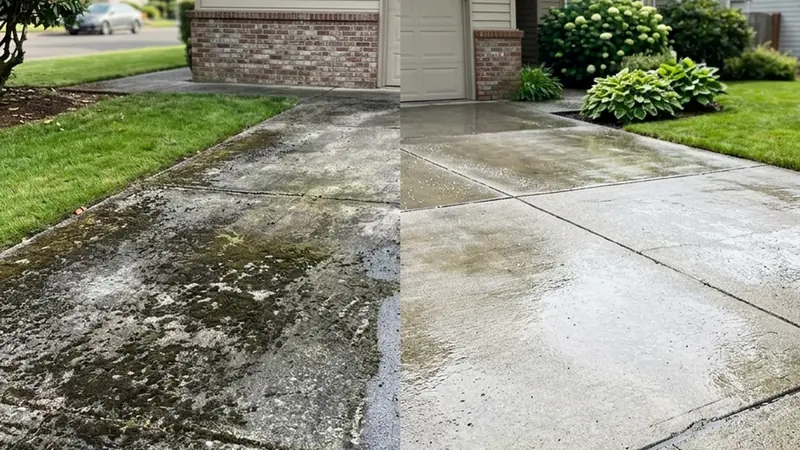
The Autumn Concrete Threat That Nobody Warns You About
Most homeowners in Summit, Medina, and Cuyahoga counties view spring as the traditional time for outdoor pressure washing. While spring cleaning is essential for washing away winter road grime, there is a second, far more critical preventative maintenance window that occurs in September and early October.
If you fail to clean your concrete driveway, walkways, and patio hardscape before the leaves fall and winter freezes arrive, your concrete will suffer permanent staining and structural surface damage that cannot be reversed by simple washing in the spring.
The Chemistry of Fall Leaf Tannin Staining
Northeast Ohio residential neighborhoods — particularly in wooded areas like Bath Township, Copley, Hudson, and Brecksville — are populated by mature oak, maple, and sycamore trees. During late September and October, these deciduous trees shed millions of pounds of wet leaves.
Oak and maple leaves contain exceptionally high concentrations of tannic acid (polyphenols). When fallen leaves lie on damp concrete for even 48 to 72 hours under autumn rains, the moisture leaches tannic acid directly out of the leaf veins and carries it deep into the open capillaries of the porous concrete matrix.
Unlike surface dust, tannic acid chemically binds with the calcium silicate hydrate compounds inside the concrete. Once winter arrives and freezes that tannin solution in place, it creates dark brown, black, and deep rust-colored leaf silhouettes that penetrate up to 1/8 inch into the surface. Standard pressure washing in the spring cannot remove deeply embedded tannin bonds without aggressive, expensive chemical acid etching.
The Winter Road Salt & Freeze-Thaw Destructive Duo
The second major reason September is the ultimate driveway cleaning month is concrete freeze-thaw physics. Northeast Ohio experiences over 60 to 80 freeze-thaw cycles between November and March. Each time snow melts and refreezes, water inside concrete pores expands by 9%.
Furthermore, Ohio Department of Transportation (ODOT) and local municipal road crews apply hundreds of thousands of tons of sodium chloride (rock salt) and calcium chloride brine to regional roads every winter. Your vehicle tires transfer this corrosive brine directly onto your driveway apron and parking pad.
When concrete enters winter coated in summer grease, organic mold bio-films, and decomposed organic matter, the concrete\'s surface porosity is compromised. The salt brine penetrates deeper, lowers the freezing point of water inside the pores, and creates extreme hydraulic osmotic pressure. This results in surface scaling, spalling, flaking, and aggregate pop-outs that permanently destroy the smooth top finish of your driveway.
The BEF 4-Stage Concrete Restoration & Protection System
At BEF Pressure Washing, our commercial driveway cleaning process utilizes heavy-duty rotary equipment that delivers results amateur wand washing cannot match:
- Hydrocarbon Pre-Treatment: We treat vehicle oil drips, transmission fluid leaks, and grease spots with commercial-grade emulsifiers that break down petroleum molecules.
- Dual-Nozzle 3,000 PSI Rotary Surface Cleaner: A 15-inch spinning spray bar operating inside a sealed containment shroud delivers uniform, streak-free cleaning across every square inch of concrete at 4 to 5 gallons per minute.
- Algae & Tannin Neutralizing Post-Treatment: We apply a penetrating 2.0% sodium hypochlorite and surfactant solution that soaks into the concrete capillaries, oxidizing remaining tannin stains and killing organic algae spores at the root.
- Optional Siloxane Penetrating Sealer: For ultimate winter defense, we apply an invisible, breathable siloxane water-repellent sealer that prevents salt brine penetration while maintaining 100% slip-resistant traction.
Why BEF Pressure Washing LLC Is the Only Logical Choice in Northeast Ohio
When searching for professional exterior cleaning across Akron, Copley, Fairlawn, Bath Township, Hudson, or surrounding Summit County communities, property owners encounter two common, flawed options: cut-rate uninsured handymen who rely on destructive high pressure, and overpriced national franchise operations that send rotating crews with zero personal accountability.
BEF Pressure Washing LLC is the trusted, owner-operated solution designed specifically for Northeast Ohio architecture and climate challenges. Founded and personally operated by Befikir Wondimu, we deliver craftsman-quality results backed by full commercial insurance, specialized equipment, and genuine local pride.
- Direct Owner-Operator Accountability: Befikir Wondimu personally oversees every residential wash and commercial project. When you contact us, you consult directly with the business owner who will stand on your driveway and ensure total perfection.
- Scientific Low-Pressure Soft Washing: We eliminate organic infestations at the root spore level using calibrated chemical solutions at under 500 PSI. We never blast water behind siding weep holes, damage window seals, or erode delicate mortar.
- Dual-Nozzle Commercial Surface Cleaners: Our 3,000 PSI rotary surface cleaners eliminate the unsightly "zebra striping" and swirl marks left behind by amateur wand washing.
- Dedicated Landscape & Pet Safety Protocols: We pre-saturate all surrounding lawns, shrubs, and perennial gardens with clean water and execute a thorough fresh-water post-rinse to ensure 100% plant safety.
- Transparent Flat-Rate Pricing & Zero Contracts: Clear, upfront estimates with zero surprise fees, no hidden trip charges, and no recurring auto-renewals.
Key Considerations When Choosing an Exterior Cleaning Specialist in Northeast Ohio
Whether you choose to perform exterior maintenance yourself or hire a professional contractor, understanding the mechanics of building materials, local climate stressors, and chemical titration is essential for protecting your property\'s structural integrity.
1. Direct Owner-Operator Oversight vs. Unmonitored Crews
In the home services industry across Summit, Medina, and Cuyahoga counties, there is a fundamental difference between working directly with an accountable local owner-operator and hiring a large regional franchise. When the business owner is personally present on your driveway, every chemical ratio, landscape pre-wetting step, and surface cleaner pass is executed with meticulous craftsman-level care. There are no rushed quotas, no unvetted temporary laborers, and no communication breakdowns.
2. The Science of Calibrated Soft Washing (<500 PSI)
Safe exterior cleaning requires understanding chemical mechanics rather than relying on raw mechanical water pressure. Delivering an active biocide (0.8% to 1.5% sodium hypochlorite blended with a thick horticultural surfactant) at under 500 PSI allows the solution to dwell on vertical siding, penetrate microscopic panel seams, and eradicate the root spores of Chlorophyta algae and Gloeocapsa magma. This process preserves vinyl locking tabs, protects window thermal seals, and prevents water infiltration behind building weep holes.
3. Commercial Rotary Surface Equipment vs. Spray Wands
On horizontal concrete driveways, walkways, and patios, professional contract cleaners utilize dual-nozzle 3,000 PSI rotary surface cleaners operating at high water volume (4.0 to 5.5 GPM). The rotating spray bar maintains an exact 1.5-inch standoff distance from the concrete slab, delivering perfectly uniform, streak-free deep cleaning without the permanent "zebra striping" caused by inconsistent hand-held spray wands.
4. Comprehensive Landscape and Environmental Safety
Professional exterior cleaning should never put your landscaping at risk. A rigorous plant protection protocol involves flood-saturating the soil and root systems of all surrounding shrubs, Japanese maples, and perennial flower beds with clean water prior to detergent application. Because plant roots can only absorb a finite volume of water, pre-saturation creates a natural hydrostatic barrier that prevents chemical uptake. An exhaustive post-rinse dilutes any residual overspray, ensuring complete safety for your gardens, pets, and family.
5. Upfront, Transparent Flat-Rate Pricing
Reputable local specialists provide straightforward, itemized flat-rate quotes based on verified cleanable square footage and surface substrate types. There should never be surprise trip fees, hidden mobilization charges, or automated recurring subscriptions. You pay only for the exact scope of work completed to your total satisfaction.
Protect Your Driveway Concrete Before Autumn Leaves Fall
Prevent permanent leaf tannin stains and winter salt spalling with a September rotary surface clean. Free estimates by phone or text.
100% Satisfaction Guarantee · Locally Owned & Operated by Befikir Wondimu · Fully Insured
The Costly Chemistry of Winter Road Salt on Dirty Concrete
When concrete enters winter covered in organic biofilms and decomposed leaf matter, the microscopic capillary network of the concrete becomes saturated with trapped water. When ODOT and municipal salt trucks spread rock salt (sodium chloride) and calcium chloride brine on Northeast Ohio roads, vehicle tires carry this chemical brine onto your driveway.
Salt accelerates damage through a process called osmotic pressure and hydraulic spalling:
- Salt lowers the freezing point of water, creating rapid, unnatural freeze-thaw cycles inside concrete pores.
- As water moves toward higher salt concentrations beneath the surface, hydrostatic pressure exceeds the tensile strength of the concrete (typically 400–500 PSI).
- The top 1/16-inch "cream layer" of the concrete fractures, causing irreversible scaling, flaking, and potholes.
Professional Concrete Sealing: Penetrating Siloxane vs. Film-Forming Sealers
Following a deep rotary pressure clean, applying a protective sealer is the ultimate winter insurance policy for your concrete:
- Penetrating Silane-Siloxane Sealers (Recommended): Penetrate up to 1/4-inch deep into concrete pores, chemically reacting to form an invisible, breathable hydrophobic barrier. Repels water and salt brine while maintaining 100% slip-resistant traction.
- Acrylic Film-Forming Sealers: Sit on top of the concrete as a glossy film. While visually appealing initially, they can become dangerously slick in freezing rain and will yellow or peel under road salt exposure.
Need exterior cleaning in Akron & Summit County?
BEF Pressure Washing provides fast, free on-site quotes.